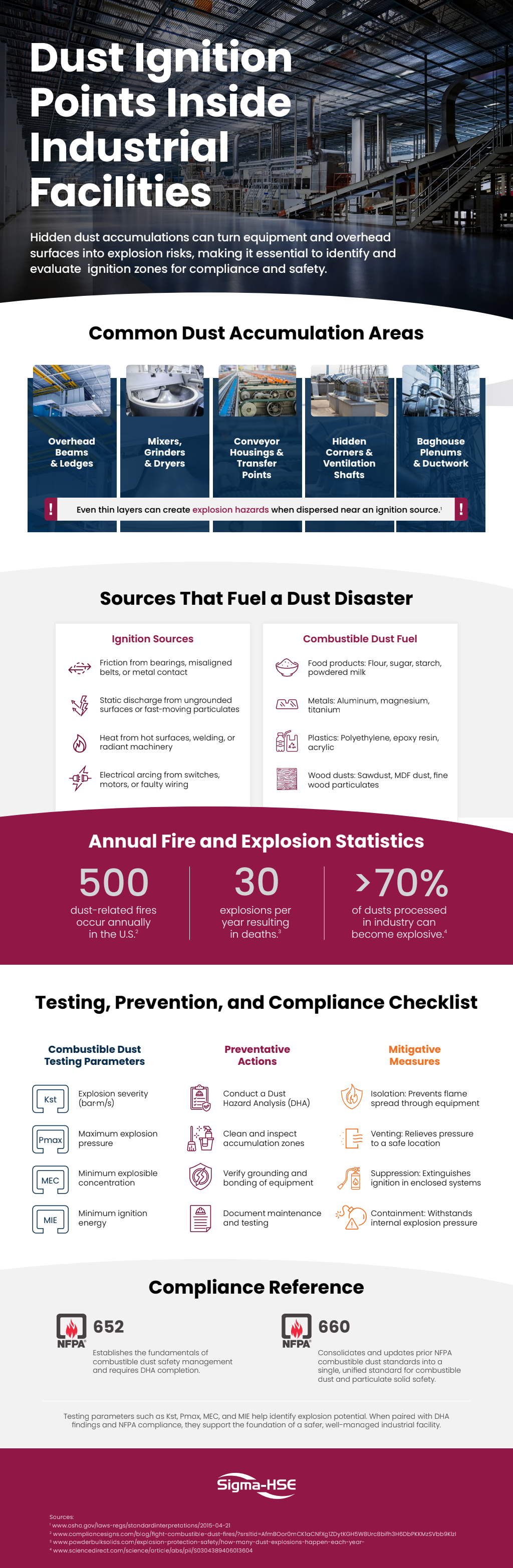
In many industrial operations, combustible dust hazards remain under-recognized. While formal assessments and major audit controls tend to focus on known equipment and fire risks, what often goes unnoticed are the subtle layers of dust accumulating in unexpected places. These hidden hazards require a proactive approach, not simply reactive firefighting.
One of the key challenges is that ignition potential and dust accumulation are interlinked. A dust layer may sit quietly on beams, ducts or corners. When an energy source arrives, however, such as static discharge, friction heat or a hot surface, it can set off a rapid reaction. What makes this especially insidious is that many materials in processing environments are capable of forming fine dust, and when dispersed or confined, they can act like fuel in an explosion scenario.
Industrial facilities must recognize that the hazard extends beyond the immediate equipment. For instance, conveyor housings, transfer points and overhead structures often lie outside standard cleaning and inspection routines. These zones may not be visible from the plant floor or may require elevated access, so they are overlooked in daily maintenance cycles. Over time, deposits build up, creating the conditions for ignition even when the dust layer appears thin.
Another important element is the relationship between ignition energy and dust conditions. Static electricity from moving particles, misaligned belts or bearing friction can introduce an ignition source. Meanwhile, dust characteristics such as moisture content, particle size and layering affect how the dust will react when energy is applied. In practice, a comprehensive review should assess both the mechanical sources of ignition and the nature of the materials present in the process.
Operational systems that handle powders or bulk materials need a documented plan. It begins with a dust hazard analysis that identifies the dust risks and maps every zone where accumulation may occur. Then the focus shifts to control: minimizing accumulation, interrupting ignition pathways through grounding and bonding, optimizing housekeeping procedures and integrating explosion protection systems when necessary. The aim is to maintain safe operating conditions consistently rather than simply reacting after an incident.
Training and culture also play a central role. Personnel need to understand that explosion risk is not restricted to visible spills or large piles. Even thin coatings can become explosive when conditions align. Maintenance, operations and safety teams must collaborate to maintain awareness of hidden zones and monitor the performance of mitigation systems.
Finally, regulatory compliance frameworks such as those referenced by Sigma-HSE guide this work. While standards define the broad safety requirements, it is the facility-specific implementation that makes the difference. A next-generation safety program integrates testing data, field observations and operational history to deliver actionable risk controls. In this way, identifying and testing ignition zones becomes not just a regulatory checkbox but a strategic component of operational resilience.
For further details on identifying ignition points, evaluating combustible dust and establishing prevention protocols, refer to the accompanying resource.